
Psalm 19 – Enlightening the Eyes
Psalm 19 extols six aspects of the Word of the LORD. Personally I find this section (v 7-9) to be one of the most poetically beautiful paragraphs in all of Scripture. Today I want to briefly focus in on one of those aspects: “The commandment of the LORD is pure, enlightening the eyes”.
To say the commandment of the LORD is pure, is to say that the law of Yahweh is without pollution – or – it is perfection. One cannot find error in the commandments that the LORD has made – after all they are the revelation of the One who gave them.
But it is the result of this pure Word that caught my attention: “enlightening the eyes”. To enlighten is to help one to see or understand. There have been a few times in my life when I held the sacred responsibility of holding the flashlight. Yes, on those occasions I was responsible to shine that light on the thing someone more skilled than I was trying to fix. But even as skilled as I am at holding a flashlight I wasn’t doing the enlightening the flashlight was.
God’s pure word is like a flashlight that helps us to see and understand. This understanding is primarily a spiritual understanding, but having spiritual understanding benefits a person in every way. Allen Ross writes, “It [God’s Word] gives people spiritual understanding and guides them in the right choices. Spiritual perception is essential for survival.” (Allen Ross, A Commentary on the Psalms)
So today and everyday open up your Bible and let it enlighten your eyes, so that you might understand, know and glorify Jesus.
Holiness of God

John’s message is this: God is Light (1 John 1:5). That message has been interpreted a few different ways, but I do believe the primary understanding is a reference to His moral purity or holiness. This is the point Martyn Lloyd-Jones makes:
I say it with reverence that before I begin to think and consider the love of God and the mercy and compassion of God, I must start with the holiness of God. I go further; unless I start with the holiness of God, my whole conception of the love of God is going to be false, and this of course is what we have been witnessing. We have had the flabby, sentimental notions of God as a God of love, always smiling upon us, and then when wars and calamities come we are baffled and we turn our backs upon religion-this is what millions have been doing since the great wars of this century. And the trouble has actually been due to the fact that they did not start the way the Scriptures start, with the holiness of God. God is utter, absolute righteousness and justice; ‘holiness, without which no man shall see the Lord’ (Heb 12:14); ‘God is a consuming fire’ (Heb 12:29); sharing in the light that is unapproachable, everlasting and eternal in the brightness and the perfection of His absolute qualities. Light! And light must not be interpreted as knowledge; light is knowledge, but light essentially stands here for holiness utter, absolute holiness and purity. And John makes certain that we shall not go astray in our interpretation, by adding this negative: ‘And in him is no darkness at all.’
Martyn Lloyd-Jones, Life In Christ
We will be considering this truth as we work our way through 1 John 1:5-10 on Sunday at Meadowview Baptist.
Nicene Creed – An Important Moment in Church History
During this past Sunday’s sermon – 1 John 1:1-4 – I briefly mentioned the Nicene Creed and it’s importance in establishing the humanity and deity of Jesus. Though we are 1700 years removed from this council I am grateful for their defense regarding the person of Jesus. Daniel Akin summarizes the situation well:
In AD 325 church leaders from around the Roman Empire gathered in Nicea (in modern day Turkey). The issue on the table was “Who is the Son?” A popular Presbyter from Alexandria named Arius said, “God became a Father, and the Son was not always; … once He was not;…He was created” (“Athanasius: Select Works and Letters” in Schaff). Two men, Alexander and Athanasius, strongly opposed this view, believing that biblical truth and the doctrine of salvation itself hung in the balance. In God’s providence the Arians were defeated, and what we know as “The Nicene Creed” was set forth as the biblical and orthodox understanding of the nature and person of Jesus. Both His humanity and His deity are beautifully affirmed. And His person and work as the Christ are wonderfully balanced. In glad confession and worship, may we also confess with our spiritual fathers that this too we believe!
Daniel Akin, Christ-Centered Exposition. Exalting Jesus in 1, 2, & 3 JohnWe believe in one God,
the Father, the almighty,
maker of heaven and earth,
of all that is,
seen and unseen.We believe in one Lord, Jesus Christ,
the only Son of God,
eternally begotten of the Father,
God from God, Light from Light,
true God from true God,
begotten, not made,
of one being with the Father.
Through him all things were made.
For us men and for our salvation
he came down from heaven;
by the power of the Holy Spirit
he became incarnate of the Virgin Mary, and was made man.
For our sake he was crucified under Pontius Pilate;
he suffered death and was buried.On the third day he rose again
in accordance with the scriptures;
he ascended into heaven
and is seated at the right hand of the father.
He will come again in glory
to judge the living and the dead,
and his kingdom will have no end.We believe in the Holy Spirit,
the Lord, the giver of life,
who proceeds from the Father and the Son.
With the Father and the Son he is worshipped and glorified.
He has spoken through the Prophets.We believe in one holy catholic [universal] and apostolic Church.
We acknowledge one baptism for the forgiveness of sins.
We look for the resurrection of the dead,
and the life of the world to come. Amen.
One final word: if you are interested in studying the life of Athanasius I would encourage you to start with this brief article by John Piper – One Man’s Joy Stood Against the Whole World. There is also a larger biography that you can read or listen too – Contending for Our All. I would commend both to you for your edification and joy.
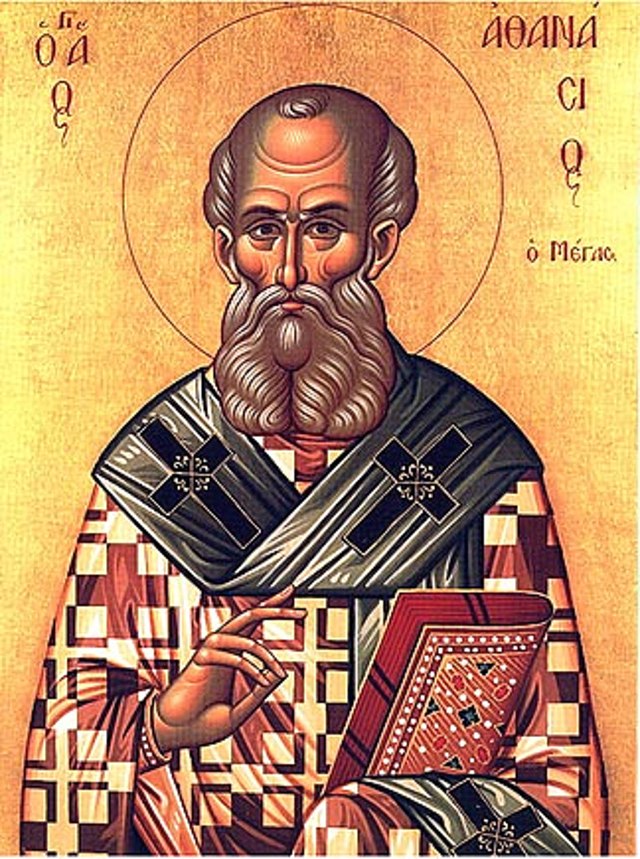
Athanasius of Alexandria
Hinderances to Fellowship

Recently at Meadowview we were working our way through 1 John 1.1-4 and discussing our fellowship with the Father, Son, and Saints. This fellowship (partnership, shared life, shared commitment) is often hindered and therefore limits our joy. As I was preparing I noted these helpful diagnostic paragraphs from Lloyd-Jones on various hinderances to our fellowship:
First of all, there is sin-unrighteousness, and we shall see how he divides that up into committed acts of sin, and the refusal to acknowledge or confess sin. Those are the ways in which sin can come between us and a conscious enjoyment of the fellowship with God. John works this out in an extraordinary manner. He has told us about this possibility of great joy; then comes in a word which almost crushes us to the ground at once: ‘This then is the message which we have heard of him, and declare unto you, that God is light, and in him is no darkness at all'(1:5) – and fellowship seems hopeless, But then, thank God, he tells us how it can be deal with. If we do not recognize and confess sin, then there is the blood which cleanses, and God is faithful and just to forgive us our sins (1:7, 9).
The second hindrance which John talks about in chapter 2 verse 3 is the lack of love to the brethren. If there is anything wrong in my relationship to God, I lose the fellowship and I lose the joy. Yes, but if there is anything wrong in my relationship to my Christian brothers and sis-ters, I also lose the joy and John works it out in a very subtle way. You lose contact with the brethren and you lose contact with God; you lose your love to God in the same way.
The third hindrance is a love of the world, a positive love for the world, a desire after, a hankering after its pleasures and its whole sinful mentality. This again is an interruption to fellowship with God. You cannot mix light and darkness, you cannot mix God and evil; therefore if you love the world you lose fellowship with God and again you lose your joy.
And the last thing which interrupts fellowship with God, he tells us at the end of the second chapter, is false teaching about the person of Jesus Christ. Obviously if the only way to God is through Christ, if I am in any way wrong about my teaching or my doctrine concerning Him, then automatically I sever the communion and again I lose my joy.
Martyn Lloyd-Jones, Life in Christ (35-36)
Psalm 11 and God’s Eyelids
As I was reading Psalm 11 this morning I noticed something unusual in verse 4 – “The LORD is in his holy temple; the LORD’S throne is in heaven; his eyes see, his eyelids test the children of man.” Notice anything unusual? For me it was the, “his eyelids” phrase. I get that the LORD’s eyes see, but I was puzzled about his eyelids that test the children of man. So I looked up the Hebrew word and sure enough eyelids is the best translation, but I still didn’t understand what the Psalmist was intending to communicate. So I turned to Keil & Delitzsch, here’s what they had to say:
“The mention of the eyelids is intentional. When we observe a thing closely or ponder over it, we draw the eyelids together, in order that our vision may be more concentrated and direct, and become, as it were, one ray piercing through the object.”
Keil & Delitzsch
This is a great example of what I love about the Hebrew language. The picture one simple Hebrew word can paint is brilliant!